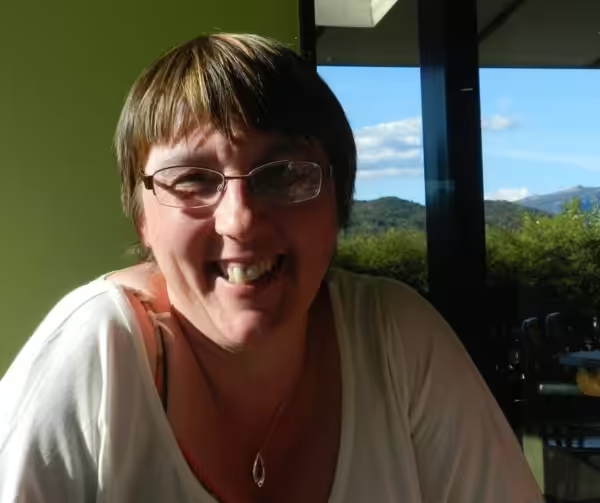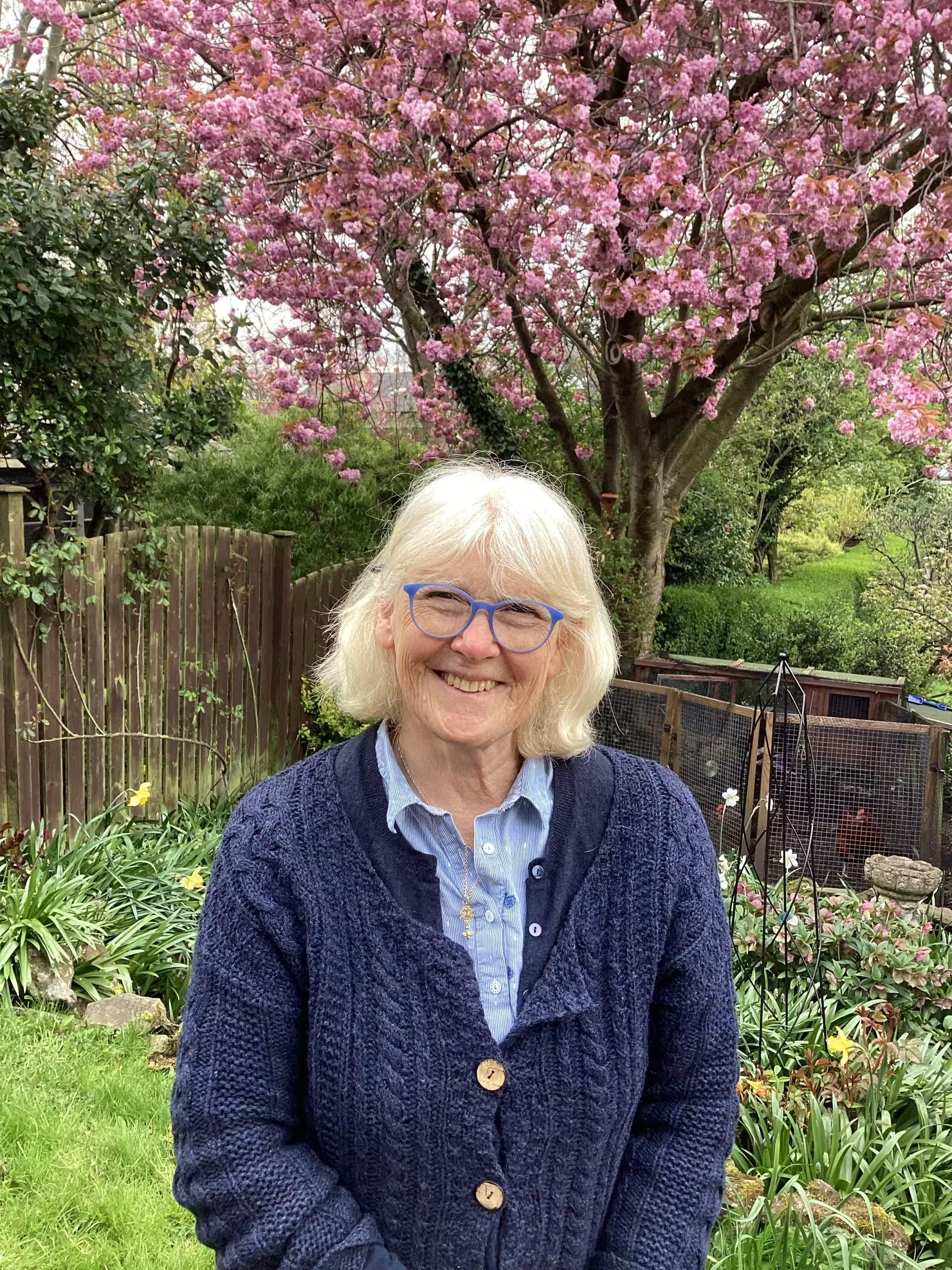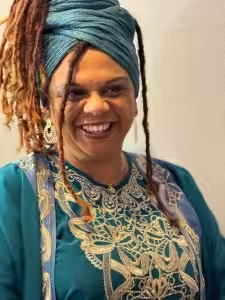
Siaa Mathurin, St Hild ordinand, mum of seven and a grandmother to soon-to-be ten grandchildren, recounts how God has faithfully led her through many church traditions, personal trials, and a lifelong call to serve those on the margins. Now in formation at St Hild, she is discovering more deeply that God wastes nothing, shaping every season of her life into a ministry rooted in justice, compassion, and joyful obedience.
Tell us a bit about yourself
I was born in Cardiff, South Wales, and from my earliest years God was quietly present. Christened in a Church of Wales church, drawn into Salvation Army worship as a child, and later shaped through Anglican schooling, Pentecostal praise, and Wesleyan holiness, my faith was formed across many traditions. Even during seasons when I drifted, God never let go of me. Looking back, I can see His steady hand long before I understood His purpose.
My first degree was in Social Science, and my working life has been rooted in people and place: housing, social regeneration, community development and engagement, mediation, social work, domestic abuse, hate crime advocacy, and supporting marginalised and racialised communities. I later studied theology at Spurgeon’s College, where I formally answered the call to ministry God had placed on my life, followed by further study in race, education, and decolonisation at Leeds Beckett. These experiences have shaped how I hold theology and practice together — always seeking to connect faith with justice and lived reality.
I am also a mum of seven and a grandmother to soon-to-be ten grandchildren. I have witnessed trauma and struggle up close, alongside deep joy and blessing. Yet through every season, God has carried me, healed me, and gently raised me up.
I am a Black neurodivergent woman, but my identity is firmly rooted in Jesus. That does not negate the intersectionality of who I am — it redeems it. My heart is for the poor, not only materially, but spiritually, socially, and relationally. As Jesus declares in Luke 4:18, He comes with good news for the poor and freedom for the captive. This shapes both my ministry and my life.
Today, I serve at St Richard’s Church in East Leeds as an Anglican ordinand, while also working for the Christian charity Wellsprings Together, whose vision is Faith in Action — walking alongside churches and communities to share God’s love in practical, dignified, relational ways.
What led you to study at St Hild? And what are you pursuing there?
God has always had a wonderful sense of humour when it comes to my calling. After years in Baptist pastoral ministry — where I was affectionately known as “Anglo-Baptist” — the Holy Spirit spoke clearly in 2022 while I was visiting Leeds: East Leeds. I resisted, of course. I had roots, family, grandchildren, and a church I loved. But obedience has become non-negotiable in my walk with God.
In April 2023, I arrived in East Leed with my youngest sons, Isaiah and Zion and soon found a spiritual home at St Richard’s Church of England. Not long after, God once again called me forward — this time into the Anglican priesthood discernment process. I am now in formation at St Hild, preparing for ordination.
St Hild drew me because of its commitment to integrated formation — holding together Scripture, theology, community, and lived experience. Here, I am being shaped not just academically, but spiritually and relationally.
I am especially grateful to Rev Dr Justin Thacker, Academic Dean, whose teaching on ethics and justice — and his work connecting global economics and theology — has deeply influenced my thinking around poverty and marginalisation. I am thankful to our Vice Principal, Rev Dr Janet Williams, whose intentional leadership ensures formation remains accessible. Dr Penny Pullan’s leadership module has helped me re-imagine leadership as shared and relational, while Dr Anna Ruddick’s work with marginalised communities continues to sharpen my commitment to justice-centred ministry. I also offer heartfelt thanks to my core tutor, Dr Jo Harbidge, whose pastoral care and willingness to create space for wrestling with difficult questions has been a profound gift, and also to Carole in the office, whose quiet faithfulness holds so much together. St Hild has given me space to integrate theology, lived experience, and vocation in ways that feel honest, challenging, and transformative.
St Hild is forming me layer by layer — teaching me that God’s purpose is not efficiency, but formation.
What is some ‘good news’ from the ministry you are involved with currently?
At St Richard’s, we are witnessing hopeful signs of renewal. Our parish is becoming increasingly diverse, and the church is responding intentionally through shared leadership, widening participation, and inclusive practices such as anonymised shortlisting. Voices once unheard are being amplified. People are finding belonging. Faith is growing. Hope is tangible.
As Vice Chair of PCC, I understand my role not as authority over others but as shared stewardship — helping to shape vision, enable gifts, and create conditions in which people can flourish. I am invited to preach regularly, lead Bible studies, participate fully in strategic discernment, and serve authentically as myself.
Alongside parish ministry, I work for Wellsprings Together, in partnership with the Diocese of Leeds, across its five episcopal areas. Our Faith in Action vision supports churches in breaking down barriers to inclusion and walking alongside their communities in practical love — through community cohesion, learning conversations, listening communities, racial justice and racial equity work, wellbeing, leadership development, and community connection. We work in and with the Diocese, which is intentional about welcoming everyone to find belonging while inviting people to join in transforming the communities we serve.
What is a surprise benefit or blessing you have gained from your study with St Hild?
One of the great surprises of St Hild has been discovering how much formation happens in community — in shared worship, late-night conversations, laughter over meals, and prayerful wrestling with complexity. Leadership here is not about polish or performance, but about presence, humility, and making space for difference.
As a Black neurodivergent woman in priestly formation, I have never found leadership neutral. Yet at St Richard’s, the Diocese of Leeds and St Hild, I have experienced what it means to be affirmed rather than merely accommodated. My neurodivergence is not framed as a limitation but often recognised as a strength. This has allowed me to lead authentically, grounded in Scripture and guided by the Spirit, without masking who God created me to be.”
Perhaps the deepest blessing has been realising that none of my journey has been wasted. From Anglican beginnings, through many expressions of the church, and now home again — not unchanged, but deepened — every season has carried God’s fingerprints. Jesus has used structure and spontaneity, Word and Spirit, certainty and questioning, to shape me layer by layer.
God, to me, is profoundly relational — faithful, loving, just, and always inviting us deeper into who we were created to be. Through joy and hardship, resistance and surrender, I testify that He truly is the Author and Finisher of my faith.
And so I stand with the words of Isaiah echoing in my heart: “Here I am, Lord. Send me.”
As I continue my formation at St Hild and prepare for ordination, I look forward with gratitude and expectancy to the next chapter of this journey — trusting that the God who called me will continue to lead, shape, and surprise me along the way.